


Successful Night Launch from Sriharikota:
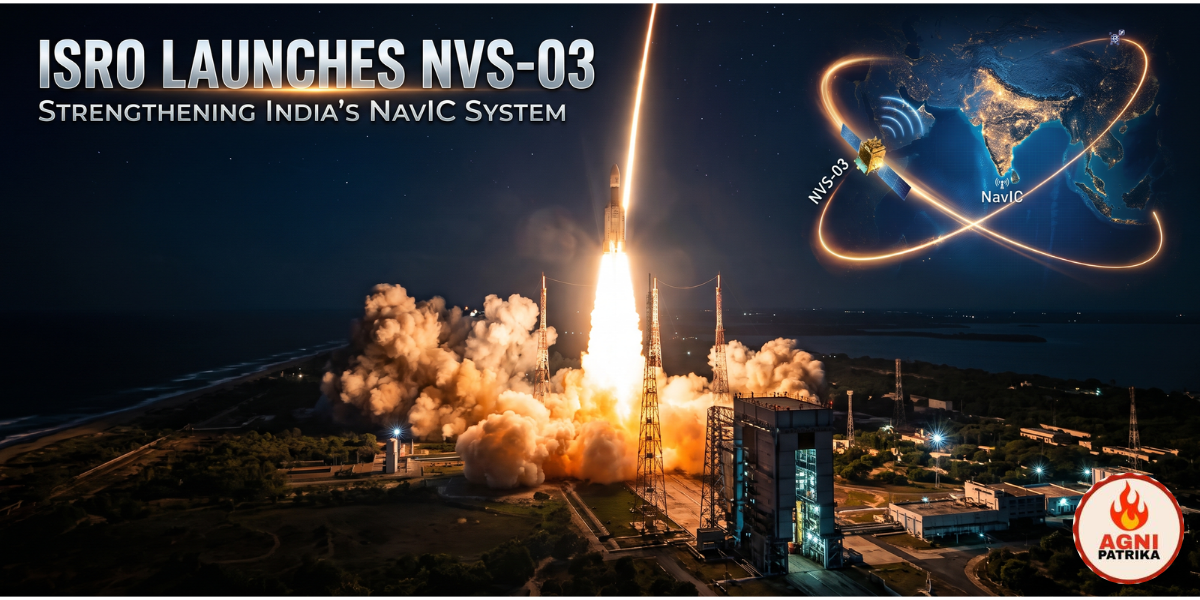
Mahi Shrivastava, Bhopal: The Indian Space Research Organisation (ISRO) successfully launched its next-generation navigation satellite, NVS-03, on Friday night, strengthening India’s indigenous NavIC satellite-navigation system.
The 2,232-kg satellite was carried into space by the GSLV-F18 rocket from the Satish Dhawan Space Centre in Sriharikota, Andhra Pradesh. The rocket lifted off at 11:51 p.m., and placed NVS-03 into a Geosynchronous Transfer Orbit. ISRO confirmed that the mission successfully achieved its objective.
GSLV-F18 was the 20th flight of India’s Geosynchronous Satellite Launch Vehicle. The launch vehicle is 50 metres tall and has three stages.
What is NavIC?
NavIC, or Navigation with Indian Constellation, is India’s regional satellite-navigation system. It is designed to provide accurate positioning, navigation and timing services across India and in an area extending about 1,500 km beyond the country’s borders.
The system serves both civilian and authorised users. Its Standard Positioning Service is available for civilian applications, while the encrypted Restricted Service is meant for authorised government and strategic users.
NVS-03 is the third satellite in ISRO’s second-generation NavIC series. It is intended to ensure continuity of navigation services provided by the earlier IRNSS satellites.
Why NVS-03 Matters?
The new satellite carries an indigenous atomic clock, along with procured atomic clocks. Atomic clocks are crucial for satellite navigation because accurate timing helps determine precise location and movement.
NVS-03 also introduces the L1 navigation frequency, in addition to the existing L5 and S-band signals. The addition of L1 is expected to improve compatibility with many smartphones and navigation devices used by the public.
The launch is particularly significant because it strengthens the reliability of NavIC after the earlier NVS-02 setback. With NVS-03 in orbit, ISRO has moved closer to maintaining an active constellation capable of providing uninterrupted navigation services.
Next Steps:
After its placement in the transfer orbit, NVS-03 will undergo a series of orbit-raising manoeuvres. It will eventually reach its designated geosynchronous position at 32.5 degrees East.
ISRO plans to deploy five second-generation navigation satellites to reinforce the existing constellation and maintain improved services. The successful NVS-03 mission marks another step in India’s effort to build an independent space-based navigation capability and reduce reliance on foreign systems for regional positioning and timing.