


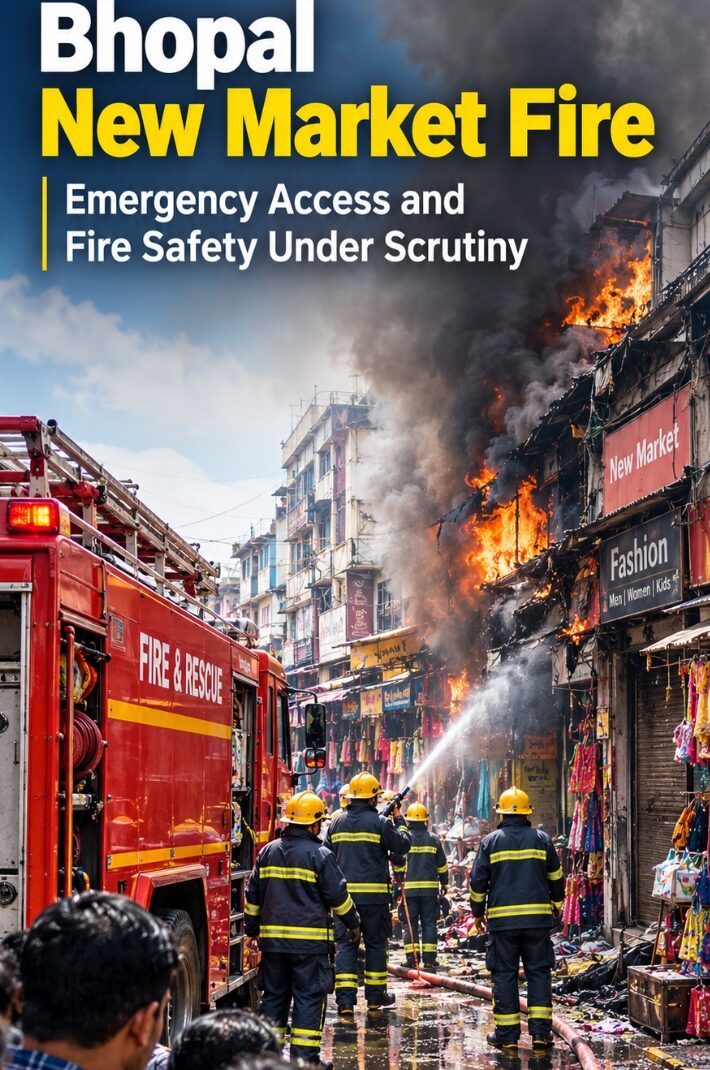
Anjali Mishra, Madhya Pradesh,Bhopal, October 10, 2026: A recent fire incident at New Market, one of Bhopal’s busy commercial areas, has brought renewed attention to fire safety, emergency vehicle access and disaster preparedness in crowded marketplaces. According to a report published on October 10, the blaze broke out on October 8, damaging five shops and causing estimated losses of approximately ₹3 crore. Fire tenders reportedly faced a delay of around 35 minutes in reaching the affected location because of access difficulties in the congested market area.
The incident has raised concerns about whether emergency services can reach crowded commercial establishments quickly enough during a major fire. It has also highlighted the need for better planning, improved access routes and regular safety inspections in markets where numerous shops operate close to one another.
New Market Fire Causes Significant Commercial Losses
New Market is an important shopping destination in Bhopal, attracting customers looking for clothing, household products, accessories, food and other everyday items. Like many established urban marketplaces, its commercial activity depends on the movement of shoppers, shopkeepers, delivery vehicles and pedestrians through busy lanes.
A fire in such an environment can quickly become a serious emergency. Closely situated shops, combustible merchandise, electrical equipment and limited movement space may complicate firefighting operations. The extent of damage depends on several factors, including the source of ignition, the materials present, the speed of detection and the effectiveness of the response.
In the October 8 incident, five shops were reportedly destroyed, with preliminary losses estimated at ₹3 crore. This figure represents a reported estimate rather than a final, independently verified assessment. The actual financial impact on individual businesses would depend on the damage to buildings, merchandise, equipment and other assets.
For small traders, even a single day of closure can affect income, employee wages, customer orders and the ability to resume normal business. A major fire may also disrupt neighbouring establishments that have not suffered direct damage but are unable to operate while the area is secured or cleared.
Why the Reported 35-Minute Delay Matters
One of the most concerning aspects of the incident was the reported delay in the arrival of fire tenders. According to the news report, emergency vehicles took approximately 35 minutes to reach the blaze because of accessibility problems in the densely crowded commercial area.
In a fire emergency, time is critical. Flames can spread from one shop to another, smoke can fill enclosed spaces, and people may struggle to leave buildings safely. A delayed response can make it more difficult for firefighters to contain a fire before it affects additional properties.
However, response time alone does not explain the entire outcome of a fire. The time taken to report the incident, dispatch emergency vehicles, locate an accessible route and begin firefighting operations all contribute to the overall response. The exact causes of the delay would need to be established through an official assessment.
The incident therefore underlines the importance of examining not only the performance of emergency personnel but also the physical conditions that determine whether emergency vehicles can reach a location.
The incident therefore underlines the importance of examining not only the performance of emergency personnel but also the physical conditions that determine whether emergency vehicles can reach a location.
Crowded Marketplaces Need Clear Emergency Routes
Commercial areas are essential to a city’s economy, but narrow lanes and obstructed passages can create serious risks during emergencies. Unauthorised parking, roadside displays, temporary stalls and goods placed outside shops can reduce the space available for fire engines and ambulances
Even when a fire station is relatively close, congestion can prevent vehicles from reaching the exact location quickly. Large emergency vehicles also require sufficient turning space and a clear approach to the affected building.
Local authorities and market associations can help address these problems by identifying emergency access routes and ensuring that they remain unobstructed. Regular inspections should check whether shop entrances, internal passages and access roads are being used in ways that could hinder emergency operations.
Where necessary, authorities can consider designated emergency corridors, improved signage, restrictions on parking in critical lanes and coordinated arrangements for moving vehicles during an incident. Any such measures should be planned around the actual layout and requirements of the market.
Fire Safety Measures That Can Reduce Risk
Preventing fires requires cooperation between municipal authorities, fire services, shop owners, property managers and customers. A practical safety programme should combine prevention, early detection and an effective emergency response.
First, electrical wiring, distribution boards and connected equipment should be inspected regularly by qualified professionals. Damaged wires, overloaded circuits and poorly maintained electrical installations can increase fire risks. Shopkeepers should avoid unsafe temporary connections and ensure that electrical work complies with applicable standards.
Second, suitable fire extinguishers and other required firefighting equipment should be installed and maintained according to the nature of each establishment. Employees should know how to raise an alarm, contact emergency services and evacuate safely. Equipment is useful only when it is accessible, maintained and used by people who understand its limitations.
Third, exits and shared passages must remain clear. Merchandise, packaging materials and other goods should not block escape routes. Buildings should have appropriate evacuation arrangements, with particular attention to customers, children, older people and persons with disabilities.
Third, exits and shared passages must remain clear. Merchandise, packaging materials and other goods should not block escape routes. Buildings should have appropriate evacuation arrangements, with particular attention to customers, children, older people and persons with disabilities.
Finally, regular fire drills and coordinated exercises involving market representatives and emergency services can help identify practical weaknesses before a real incident occurs.
Responsibility of Authorities and Market Associations
Following the incident, the reported access difficulties have put the preparedness of crowded commercial areas under scrutiny. The Bhopal Municipal Corporation has acknowledged problems relating to emergency access in congested zones, according to the report published on October 10.
The next step should be a systematic review of vulnerable marketplaces. Such an assessment could identify locations where fire engines cannot enter easily, roads where parking routinely obstructs movement and buildings that require improvements to their fire safety arrangements.
Market associations can support this process by communicating safety requirements to shopkeepers, organising awareness campaigns and helping authorities keep shared access routes clear. Shop owners should also maintain emergency contact information and ensure that staff members know the appropriate evacuation procedures.
Authorities may also examine whether existing inspection and enforcement arrangements are adequate. Any proposed action should be based on documented findings, applicable regulations and the specific conditions of the affected area.
A Reminder for Bhopal’s Urban Planning
The New Market fire is a reminder that urban safety depends on more than the availability of emergency vehicles. Roads, building layouts, parking arrangements, early-warning systems and public awareness all influence how effectively a city responds to a crisis.
As Bhopal continues to grow, commercial areas must remain accessible to shoppers while also meeting essential safety requirements. Development and business activity should not come at the cost of safe evacuation routes or emergency access.
The reported losses of ₹3 crore and the delay faced by fire tenders make this incident particularly significant for traders and city administrators. A detailed review of the response, followed by practical corrective measures, could help reduce similar risks in the future.
The October 8 fire at Bhopal’s New Market has brought the issue of emergency access into focus. Protecting businesses and lives requires clear routes for fire tenders, properly maintained safety equipment, regular inspections and cooperation between authorities and traders. The key challenge now is to turn the lessons from this incident into measurable improvements in fire preparedness across the city.