


Feature by: Swapnaleena Paul
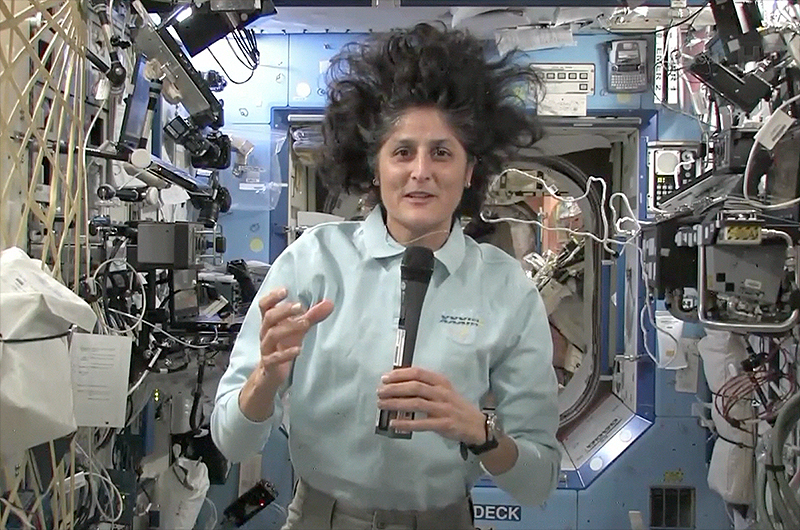
As Sunita Williams formally retires from active service today, her departure feels less like a farewell and more like the closing of a well-worn logbook, its pages filled with precision, courage, and quiet endurance. For over two decades, Williams has been one of the most recognisable faces of human spaceflight, a figure who bridged generations of exploration from the Space Shuttle era to the age of commercial spacecraft. Her retirement does not simply conclude a career; it marks the end of a particular rhythm of spaceflight defined by discipline, adaptability, and an unshakeable sense of duty.
In an age of viral moments and rapid technological turnover, Williams stood out for something rarer: longevity built on trust. NASA entrusted her repeatedly with long-duration missions, complex spacewalks, and, most recently, an unplanned extension aboard the International Space Station that tested both human patience and institutional resilience. It is fitting, then, that her retirement invites reflection not just on what she achieved, but on how she carried herself through every chapter of her journey.
From Massachusetts to the Stars
Born in Euclid, Ohio, in 1965 and raised in Needham, Massachusetts, Sunita Lyn Williams grew up far from launchpads and mission control rooms. Her upbringing, however, was deeply rooted in discipline and curiosity. Her father, Dr. Deepak Pandya, emigrated from Gujarat, India, while her mother, Bonnie Pandya, is of Slovene descent. Williams has often spoken about how this multicultural background shaped her worldview, giving her an instinctive appreciation for global cooperation long before she entered an international space station.
Williams graduated from the United States Naval Academy in 1987, earning a Bachelor of Science degree in physical science, and later completed a master’s degree in engineering management from the Florida Institute of Technology. Her early career followed a demanding naval aviation path. She became a helicopter pilot, flying H-46 Sea Knight helicopters, and later trained as a test pilot, a role that requires equal parts courage, analytical thinking, and emotional control.
By the time she was selected as an astronaut by NASA in 1998, Williams had already accumulated thousands of flight hours and a reputation for calm competence. Space, in many ways, became a natural extension of the cockpit she already knew.
Becoming an Astronaut
Williams’s astronaut training years coincided with a transitional phase in human spaceflight. The Space Shuttle was still operational, but the International Space Station was steadily growing into humanity’s most ambitious collaborative scientific project. Her early work involved technical assignments, robotics support, and preparations that rarely make headlines but are essential to mission success.
Her first spaceflight came in 2006, when she launched aboard Space Shuttle Discovery as part of Expedition 14 and 15 to the International Space Station. What was intended as a six-month mission stretched longer, giving Williams her first experience of extended life in microgravity. It was here that she began building the reputation that would define her career: dependable, unflappable, and endlessly prepared.
Life in Microgravity and Records That Followed
Across three long-duration missions, Williams accumulated a total of 608 days in space, placing her among the most experienced astronauts in history. Numbers alone, however, tell only part of the story. Life aboard the ISS is an exercise in controlled monotony punctuated by moments of extreme responsibility. Astronauts maintain life-support systems, conduct scientific experiments, repair hardware, and prepare for contingencies that may never arise but must always be anticipated.
Williams performed nine spacewalks, spending more than 62 hours outside the station. This remains the highest total extravehicular activity time recorded by a woman. Each spacewalk demanded years of preparation, physical endurance, and the ability to solve problems in an environment where even a small mistake can have severe consequences.
She also became widely known for moments that humanised spaceflight. In 2007, Williams ran the Boston Marathon on a treadmill aboard the ISS, becoming the first person to complete a marathon in space. While symbolic, the feat highlighted the rigorous physical maintenance required of astronauts and captured public imagination in a way few technical achievements do.
Leadership in Orbit
During her later missions, Williams served as commander of the International Space Station, a role that extends beyond technical authority. The ISS commander manages international crews, coordinates with multiple ground control centres across the world, and ensures both mission objectives and crew well-being are balanced effectively.
Williams’s leadership style was marked by quiet clarity rather than theatrics. Colleagues frequently described her as calm under pressure and deeply respectful of the station’s multicultural environment. In orbit, cultural sensitivity is not a courtesy but a necessity, and Williams’s background and temperament made her particularly well suited to the role.
The Starliner Mission and an Unexpected Chapter
The final phase of Williams’s career unfolded during the Boeing Crew Flight Test of the CST-100 Starliner spacecraft in 2024. Alongside fellow astronaut Butch Wilmore, Williams piloted the mission intended to certify Starliner for regular crewed flights. It was a milestone moment for commercial spaceflight and a testament to NASA’s evolving partnership model.
However, technical issues with the spacecraft’s propulsion system altered the mission dramatically. What was planned as a short-duration test flight turned into an extended stay aboard the ISS. Williams and Wilmore remained on the station for months longer than anticipated, adapting to a situation that required patience, flexibility, and constant reassessment by teams on Earth.
The episode placed Williams at the centre of global attention once again, not for records or firsts, but for her composure. Her ability to continue routine station operations under unusual circumstances reinforced the very qualities that defined her career. When she finally returned to Earth in 2025 aboard a different spacecraft, the mission had already secured its place in spaceflight history.
Representation and Inspiration
Beyond mission logs and technical achievements, Williams’s influence is deeply cultural. As one of the most prominent Indian-American astronauts, she has long been a symbol of representation in science and exploration. Her visits to India, interactions with students, and consistent emphasis on education have inspired countless young people to imagine futures in science, engineering, and aviation.
Williams never framed her achievements as exceptional because of her identity, but she never downplayed their importance either. She understood that visibility matters, especially in fields where opportunity can feel distant. Through her career, space became a little more accessible to those who saw themselves reflected in her story.
The Meaning of Retirement
Retirement from NASA does not mean withdrawal from the space community. Former astronauts often transition into advisory roles, industry leadership, education, or public engagement, and Williams’s experience makes her an invaluable voice in all these spaces. Her knowledge spans government-led missions, international cooperation, and commercial crew development, a rare combination in a rapidly changing industry.
Her retirement also arrives at a symbolic moment. Human spaceflight stands at a crossroads, balancing ambition with caution as new technologies and private players redefine how humans reach orbit. Williams represents continuity in that transition, a reminder that while hardware evolves, the human qualities required for exploration remain constant.
A Legacy Written in Orbits
As Sunita Williams steps away from active duty, her legacy is already secure. She leaves behind records, procedures, and scientific contributions, but more importantly, she leaves an example. Her career demonstrates that exploration is not only about bold leaps but also about sustained commitment, teamwork, and humility in the face of the unknown.
For future astronauts, her journey offers a blueprint built on preparation rather than spectacle. For the public, it offers reassurance that even in the most complex and risky endeavours, steadiness still matters.
Retirement closes one chapter of Williams’s life, but it does not diminish her presence in the story of spaceflight. Her influence will continue to orbit through classrooms, control rooms, and the aspirations of those who look up at the night sky and believe that persistence can, quite literally, take you beyond Earth.