


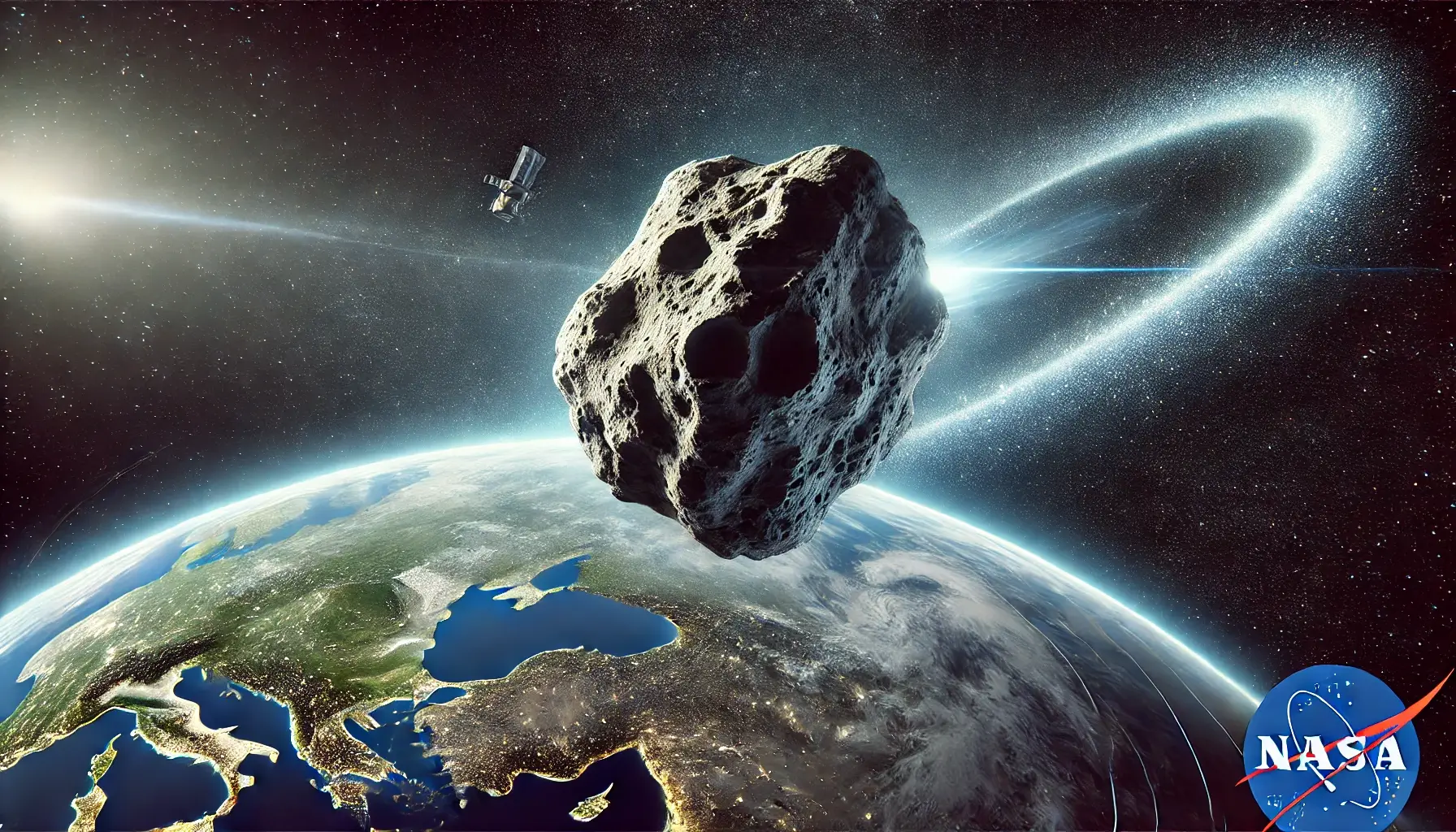
Kajal Jatav: NASA has confirmed that asteroid 2025 MM, which is over 120 feet across and comparable to a small aircraft, will have a close approach to Earth on July 1, 2025. The nearest point of the flyby would be about 1.29 million kilometres (roughly 800,000 miles). This asteroid will come close at a speed of around 38,428 km/h (23,874 mph), like many near-Earth objects intersecting our planet’s orbit. Scientists insist, however, that despite such dramatic-sounding figures, there is no danger at all—the flyby is quite safe and bears no collision threat.
Why Do Scientists Track These Speedy Visitors?
This particular asteroid comes from the Aten category, and such asteroids are near-Earth objects that frequently pass through Earth’s orbit. While most of the Aten asteroids aren’t dangerous, being close in orbits means that an initial nudge, even the tiniest one from a planet or from solar radiation, can alter their paths. Regular checks should help ensure that we detect any future risks as early as possible. At the moment, however, 2025MM does not qualify as a hazard under NASA’s classification requirements (which mean that objects need to be larger than about 150 m and pass within ~7.4 million km).
What Makes This Flyby Special?
- Size – About 120 feet wide, 2025 MM is about the same as the wingspan of a Boeing 737 – large enough to be locally destructive if it were to strike the ground, but it generally is not cataclysmic.
- Speed and distance – Approaching at a velocity of nearly 40,000 km/h, it will have a near miss of 1.29 million km, representing a unique opportunity for astronomers to observe one of their fast-moving neighbours.
- Observation Opportunity – Such an event represents an opportunity for radar and optical observations to collect data on size, composition, and rotation for eventual planetary defense planning.
The Bigger Picture: Planetary Defence in Action
Programs such as NASA’s Asteroid Terrestrial-impact Last Alert System (ATLAS) are keeping a watchful eye on the skies and have successfully detected small but significant asteroids such as these, one days to weeks before the close approach.
While 2025 MM is currently safe, it is a timely reminder that space is ever-changing and should be closely surveyed for objects large enough to pose a threat to Earth. Global efforts led by NASA, the ESA, ISRO, and others are ramping up to improve strategies for detection and response, including kinetic-deflection tests like the DART mission.
One more event increases our knowledge and ability to one day protect Earth from an actual hazardous asteroid; while not a threat in itself, it emphasizes the need for maintaining a robust planetary defence and, of course, continued monitoring.
In any case, keep watching the skies—today’s intruder in our universe reminds us how dynamic our celestial neighbourhood is!