


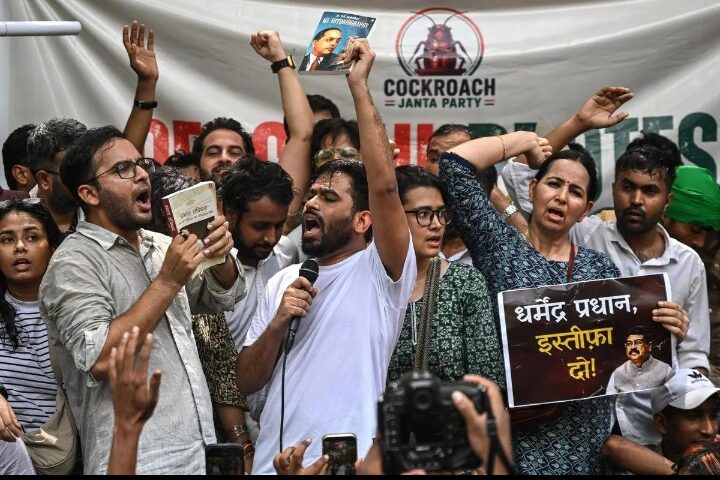
Anjali Mishra, NEW DELHI, INDIA : New Delhi witnessed a fresh wave of youth-led protests on Friday as thousands of demonstrators gathered in Connaught Place, raising concerns over voter-list revisions and demanding the resignation of Chief Election Commissioner Gyanesh Kumar. The demonstrations have brought renewed attention to electoral transparency, democratic accountability and the role of young citizens in India’s political landscape.
According to reports published by The Associated Press and Reuters on October 16, protesters associated with the youth-led Cockroach movement participated in demonstrations against the ongoing revision of electoral rolls. The campaign has attracted students, young activists and opposition supporters who have questioned the process through which names have been removed from voter lists.
Voter-List Revision Becomes the Centre of Protests
The primary issue behind the demonstrations is the Election Commission’s Special Intensive Revision (SIR) of electoral rolls. Protesters and opposition parties allege that the process risks excluding eligible voters and have called for greater transparency in its implementation.
Reports indicate that more than 130 million names have been removed from voter lists during the revision process since last year. Critics argue that the scale of the removals requires careful scrutiny to ensure that eligible citizens are not deprived of their voting rights.
The Election Commission and the central government have rejected allegations of politically motivated action. They maintain that the revision is intended to identify duplicate entries and remove ineligible names from electoral rolls.
The disagreement has developed into a wider political debate over how voter lists are updated, how citizens can challenge deletions and what safeguards are necessary to protect the right to vote.
Youth Movement Gains National Attention
The movement has gained visibility through demonstrations and social media activity. Its supporters say young people need to participate actively in public affairs and question institutions when they believe citizens’ rights may be at risk.
The latest demonstrations indicate that the campaign has expanded beyond its earlier focus on education and employment concerns. Electoral transparency has now become a major issue for its supporters.
The Cockroach movement has emerged as a prominent youth-led protest campaign in recent months. What began as an online satirical initiative developed into a broader movement addressing issues including employment, examination-paper leaks and government accountability.
However, the movement’s long-term political influence remains uncertain. While it has attracted public attention, it is too early to determine whether its activities will translate into sustained electoral change.
Security Measures Introduced in the Capital
Authorities increased security arrangements in and around Connaught Place ahead of the planned demonstration. Police deployed personnel at strategic locations and imposed restrictions on gatherings in certain areas.
The New Delhi Municipal Council also announced that Central Park in Connaught Place would remain closed to the public on October 16 and 17 for administrative reasons..
Police urged people to avoid restricted areas and warned that violations of applicable orders could invite legal action. The arrangements reflected concerns about public safety, crowd management and possible disruption in a busy commercial district.
The restrictions also became part of the political debate, with movement supporters questioning the limitations placed on demonstrations. The incident highlights the challenge of balancing public order with citizens’ rights to peaceful assembly and expression.
Political Disagreement Continues
Opposition parties have criticised the voter-list revision and demanded answers regarding the removal of names. They argue that electoral processes must be transparent and that eligible voters should have accessible procedures for checking their registration status and correcting errors.
The government and the Election Commission have denied claims of deliberate manipulation, saying the revision aims to improve the accuracy of electoral rolls.
The competing positions have made the issue a significant point of political disagreement. Independent verification, clear public information and effective grievance-redressal mechanisms will be important in addressing concerns about voter registration.
The controversy also raises questions about how election authorities communicate changes to voters and ensure that people understand the procedures for checking their names on electoral rolls.
Employment and Education Concerns Add to Youth Discontent
The protests are taking place against a wider backdrop of youth dissatisfaction over employment opportunities, education and examination irregularities. Reuters reported on October 16 that concerns about job creation, examination-paper leaks and perceived inequality have contributed to the broader climate of public discontent.
For many young citizens, participation in demonstrations represents an opportunity to express concerns about their future and the functioning of public institutions.
Employment and education remain particularly important issues for young people entering the workforce.
When expectations about opportunities and public accountability are not met, dissatisfaction can spill over into wider political movements.
Nevertheless, the concerns of protesters should not be treated as representing every young Indian. Public opinion is diverse, and the movement’s broader impact will depend on how these issues develop over time.
Why Electoral Transparency Matters
Free and fair elections depend on accurate voter lists, accessible registration procedures and public confidence in election administration. The removal of ineligible or duplicate entries is a legitimate administrative objective, but safeguards are equally important to prevent eligible voters from being excluded accidentally.
Transparent procedures for notifying affected citizens, correcting errors and resolving complaints can help protect voting rights. Clear explanations from authorities and independently verifiable information can also reduce confusion and misinformation.
The protests underline the importance of dialogue between citizens, political parties and election authorities. Addressing specific complaints through established legal and administrative mechanisms may help restore confidence in the electoral process.
What Lies Ahead?
The political consequences of the demonstrations remain uncertain. The controversy is likely to continue generating debate about voter registration, freedom of expression and the relationship between young citizens and political institutions.
The next steps will depend on how authorities respond to concerns, whether the disputed issues receive further scrutiny and whether protesters continue to mobilise around electoral transparency and other public concerns.
For now, the demonstrations have placed voter-list revisions firmly in the national conversation. The central question remains how India can ensure that electoral administration is both accurate and trusted by the citizens whose democratic participation it is designed to protect.
The protests in New Delhi reflect a growing public debate over electoral transparency and youth participation in politics. As allegations and official denials continue to shape the discussion, credible information, transparent procedures and respect for democratic rights will be essential to maintaining public confidence.