


Feature By: Swapnaleena Paul.
It is impossible to remember Alan Rickman without first seeing him as Severus Snape, black robes flowing, lips curled into a permanent sneer, eyes sharp enough to wound. For a generation raised on the Harry Potter films, Rickman was Snape: the professor who terrified students, punished Gryffindors, and seemed to delight in cruelty. Yet beneath that controlled menace lay a grief stricken soul, a revelation that would not fully arrive until the saga’s final chapters.
That duality, fear and tenderness, darkness and devotion, was not just Snape’s story. It was Alan Rickman’s gift to cinema. Ten years after his passing on January 14, 2016, his absence still feels personal, as though the world lost not merely an actor, but a voice, a conscience, and a quiet moral compass.
The Power of Snape: A Performance Built on Restraint
Rickman’s Severus Snape remains one of the most layered performances in blockbuster cinema. What made it extraordinary was not excess, but restraint. He rarely raised his voice. He did not overplay villainy. Instead, he weaponized silence, pauses, and that famously measured drawl.
Across eight Harry Potter films, Rickman played the longest emotional game imaginable. Long before audiences knew Snape’s true allegiance, Rickman did. Author J.K. Rowling privately told him the truth about Snape’s love for Lily Potter and the meaning behind the word “Always,” allowing Rickman to seed moments of sadness and sacrifice into scenes that initially read as coldness.
A glance held half a second too long. A breath before a line. A bitterness that felt rooted in heartbreak rather than malice. When Snape finally answered Dumbledore’s question, “After all this time?” with a steady, devastating “Always,” it did not feel like a plot twist. It felt like a truth we had been circling for years.
In remembering Alan Rickman, we begin with Snape not because it defines him, but because it demonstrates his rare ability to trust intelligence, his own and the audience’s.
Before the Screen: A Late Bloomer With a Designer’s Eye
Unlike many actors who chase the spotlight from youth, Alan Rickman arrived at stardom later than most. Born in London in 1946, he lost his father at a young age, an experience that shaped his worldview and instilled a quiet seriousness that would later surface in his work.
Rickman initially trained as a graphic designer, studying at Chelsea College of Art and Design and later at the Royal College of Art. He even co founded a design studio, Graphiti. This visual training stayed with him. He understood composition, balance, and negative space, skills that translated seamlessly into his acting. He knew how to frame himself within a scene, how stillness could command attention more powerfully than movement.
It wasn’t until his thirties that he fully committed to acting, training at the Royal Academy of Dramatic Art. By the time he reached the stage professionally, he carried with him a maturity that younger actors often lack. He did not rush emotion. He sculpted it.
Breakthrough and the Birth of an Iconic Villain
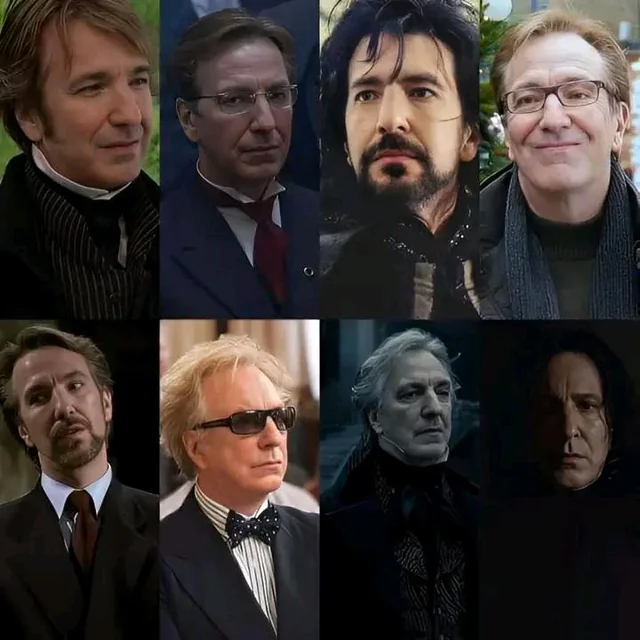
Rickman’s international breakthrough came not as a hero, but as one of cinema’s most unforgettable antagonists: Hans Gruber in Die Hard.
Gruber was not a brute. He was elegant, intelligent, and impeccably dressed, a villain who spoke like a gentleman and killed with calculation. Rickman transformed what could have been a standard action movie bad guy into a character of wit and sophistication. His accent, cadence, and amused cruelty elevated the film and redefined the modern cinematic villain.
Hollywood took notice. But Rickman resisted being boxed in. Even as studios offered him similar roles, he deliberately chose projects that challenged expectations.
Romance, Vulnerability, and Emotional Precision
For every Hans Gruber or Snape, there was a Colonel Brandon. In Sense and Sensibility, Rickman delivered one of the most moving romantic performances of the 1990s. As the reserved, quietly devoted Brandon, he embodied patience and moral integrity. His love was expressed not through grand speeches, but through unwavering presence.
This ability to express longing without sentimentality became a hallmark of his career. In Truly, Madly, Deeply, he played a man who returns as a ghost, not to haunt, but to heal. The film allowed Rickman to reveal warmth, humor, and emotional nakedness, proving he was far more than the cool intellectual roles he was often cast in.
The Actor Who Chose Substance Over Stardom
Rickman’s filmography is a study in deliberate choices. From Robin Hood: Prince of Thieves, where his Sheriff of Nottingham stole every scene with gleeful excess, to Galaxy Quest, where he affectionately skewered actors trapped by iconic roles, Rickman never looked down on genre.
He believed seriousness of intent mattered more than prestige. Comedy, fantasy, period drama, and action all deserved the same rigor. He also championed theatre throughout his life, returning to the stage repeatedly even after global fame.
As a director, Rickman showed the same sensitivity. His film A Little Chaos reflected his love for art, restraint, and emotional understatement, values that defined him.
A Private Battle: Health, Illness, and Quiet Dignity
In August 2015, Rickman suffered a minor stroke. During medical examinations that followed, doctors discovered he had pancreatic cancer. True to his nature, Rickman kept his diagnosis largely private, informing only close friends and family.
He continued working for as long as he could, choosing dignity over disclosure. When he passed away on January 14, 2016, at the age of 69, the news shocked the world. There had been no prolonged public farewell, no media spectacle, just sudden silence.
It was only afterward, through tributes and the posthumous publication of his diaries Madly, Deeply, that fans learned how deeply thoughtful he had been about mortality, art, and kindness in his final months.
The Man Behind the Voice
Those who knew Rickman consistently describe him as generous, politically engaged, and deeply humane. He supported countless charities, advocated for social justice, and mentored young actors without fanfare. He loathed cruelty, both on screen when it lacked purpose, and off screen in real life.
His voice, often parodied and instantly recognizable, was once described by linguists as possessing near perfect tonal balance. But it was not just an instrument of authority. It carried irony, warmth, and vulnerability. He could make a single line resonate long after the scene ended.
Rickman once said that acting was about listening more than speaking. Perhaps that is why his performances linger. They feel like conversations we are still finishing.
Ten Years Later: Why Alan Rickman Still Matters
A decade after his death, Alan Rickman’s work continues to be rediscovered by new audiences. Children meet him first as Snape, then grow older and encounter Colonel Brandon, Hans Gruber, and the quietly broken men scattered across his career. Each time, they find something new.
Rickman mattered because he trusted complexity. He believed audiences could sit with discomfort, ambiguity, and silence. In an era increasingly driven by speed and spectacle, his performances remind us of the power of stillness.
To remember Alan Rickman is not merely to revisit his films. It is to remember a way of being, thoughtful, principled, and uncompromisingly sincere.
Ten years on, the robes may have settled, the voice may have faded into recordings, but the presence remains.
Always.