

Report by: Swapnaleena Paul:The fatal shooting of Renee Nicole Good during a federal immigration raid has ignited protests, lawsuits, and renewed scrutiny of how immigration enforcement is carried out in America’s cities.
Minneapolis, Minnesota: On the morning of January 7, 2026, a federal immigration enforcement operation unfolding on the streets of Minneapolis ended with the death of a 37-year-old woman and set off one of the most consequential confrontations yet between federal authority and local governance in the United States. Renee Nicole Good was shot and killed by an officer with U.S. Immigration and Customs Enforcement during what the Department of Homeland Security described as a large-scale enforcement action targeting immigration violations in the Minneapolis–Saint Paul metropolitan area. Within hours, the killing became the center of a rapidly expanding controversy-one that now encompasses criminal investigations, civil lawsuits, mass protests, and a national debate over the reach and accountability of federal immigration enforcement.
According to federal officials, the ICE agent involved fired his weapon in self-defenses after perceiving an imminent threat, alleging that good attempted to use her vehicle to strike officers during the operation. The officer, later identified as Jonathan Ross, is a veteran of both military and law enforcement service, a fact repeatedly emphasized by DHS in public statements defending the use of force. But that official account was soon challenged by witnesses, local officials, and video recordings that surfaced in the hours and days following the incident. Those competing narratives-one framing the shooting as justified under threat, the other questioning whether lethal force was warranted at all-have become the fault line of a widening crisis.
Good was unarmed when she was shot. Friends and family described her as a mother, artist, and community member who had been in the area after dropping her child at school earlier that morning. Her death occurred in a residential neighborhood, near homes and schools, at a time of day when pedestrian activity was high. That setting has loomed large in public reaction, as residents questioned why a heavily armed federal operation was conducted in such close proximity to civilian life with little warning or coordination.
The enforcement action itself was part of what federal authorities described as an unprecedented surge of immigration agents into the region. DHS officials said the operation was designed to address immigration fraud and related offenses, but local leaders later stated that they had not been fully informed of its scope or tactics. Residents reported seeing numerous federal vehicles, armed agents, and enforcement teams operating openly in neighborhoods unaccustomed to such displays of force. For many, the presence created fear and confusion, particularly among immigrant families and school communities.
Within hours of the shooting, Minneapolis officials publicly questioned the federal account of events. As additional videos circulated-some filmed by bystanders, others by journalists-city leaders said the footage raised serious concerns about whether Good posed an immediate threat at the time she was shot. The release by federal authorities of selected video clips intended to support the self-defenses claim did little to ease tensions, instead fueling accusations that the government was controlling the narrative while withholding broader context.
The dispute quickly moved beyond the facts of a single encounter and into the realm of institutional trust. Responsibility for investigating the shooting was transferred to the Federal Bureau of Investigation, a standard procedure when federal agents are involved in fatal use-of-force cases. But Minnesota officials expressed unease with the arrangement, arguing that a federal-led investigation into federal conduct risks eroding public confidence. Calls mounted for greater transparency, independent oversight, and full public release of all available evidence, including body-camera footage, internal communications, and after-action reports.
As legal questions multiplied, political ones followed. Within days, the State of Minnesota, joined by the cities of Minneapolis and Saint Paul, filed a lawsuit seeking to halt or restrict the federal enforcement operation. The suit argues that the deployment exceeded lawful authority, endangered residents, and violated constitutional protections, particularly in communities already vulnerable to aggressive policing. Legal experts say the case could have far-reaching implications, potentially clarifying how far federal agencies can go when conducting immigration enforcement in jurisdictions that oppose such tactics.
While the legal battle began to take shape, the streets told a parallel story. Vigils for Good turned into mass demonstrations, first in Minneapolis and then across the country. Tens of thousands of people marched, demanding justice, accountability, and an end to what they described as militarized immigration enforcement. Some protests resulted in arrests as tensions flared, underscoring the depth of anger and grief that had been unleashed. What began as a localized tragedy had become a national mobilization.
Federal officials urged restraint, cautioning against conclusions before investigations were complete. DHS leaders defended the enforcement operation and warned that misinformation was inflaming public sentiment. But critics countered that the pattern was familiar: a deadly encounter followed by official justifications, selective disclosures, and delayed accountability. For many protesters and civil liberties advocates, the issue was not only whether one officer acted appropriately, but whether the system that placed him there made such an outcome more likely.
The rhetoric surrounding the incident further sharpened divisions. Statements from federal officials characterizing certain forms of interference or protest as extremist behavior drew backlash from civil rights groups, who warned against conflating dissent with criminality. Analysts noted that large-scale, high-visibility enforcement operations in residential areas increase the risk of miscalculation, particularly when civilians attempt to observe, record, or question federal actions. In such environments, fear and confusion can escalate rapidly, with deadly consequences.
As weeks pass, the future of the case remains uncertain. It is not yet known whether federal prosecutors will bring criminal charges, how the courts will rule on Minnesota’s lawsuit, or whether DHS will revise its operational practices. What is already clear is that the killing of Renee Nicole Good has become a defining moment in the on-going debate over immigration enforcement in the United States.
At its core, the incident forces a reckoning with fundamental questions: Who holds power when federal agents operate in local communities? How is that power checked? And what mechanisms exist to prevent the loss of civilian life when enforcement priorities collide with everyday life? The answers will shape not only the outcome of this case, but the future of how immigration policy is enforced on American streets.
For Good’s family, the stakes are deeply personal. For Minneapolis, they are civic and constitutional. And for the nation, they are emblematic of a broader struggle to reconcile law enforcement, federal authority, and human dignity in an era of polarized politics and high-stakes governance. Whether this moment leads to accountability and reform-or becomes another unresolved chapter in a long history of contested enforcement-will depend on what happens next, in courtrooms, in government offices, and in the public square.
A Killing, a Crackdown, and a City in Revolt: How an ICE Operation in Minneapolis Sparked a National Reckoning.

Byagnipatrikadesk
Jan 13, 2026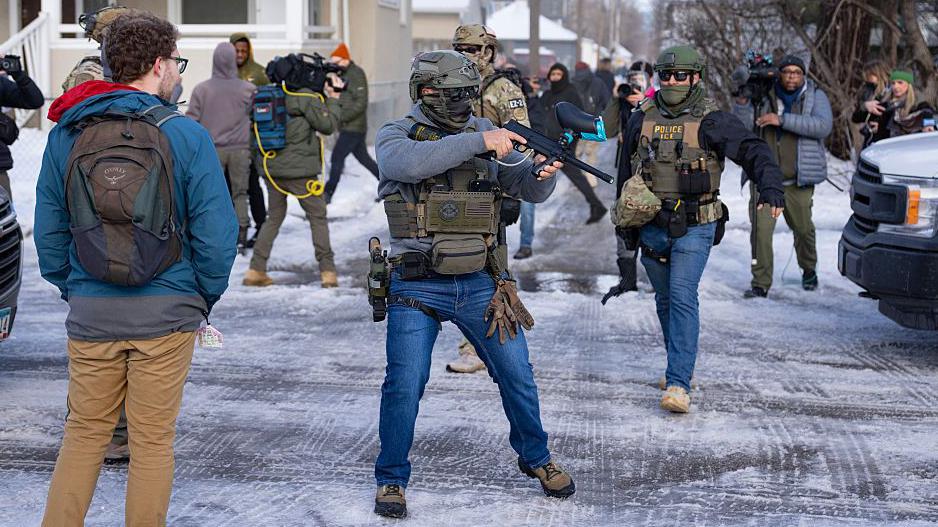 "A federal agent aims a projectile launcher as bystanders and media film an enforcement action in Minneapolis. The high-visibility deployment of roughly 2,000 agents into residential areas became a central point of contention following the fatal shooting of Renee Nicole Good."